AI Collaging for Content Creation
Maximizing output, minimizing time

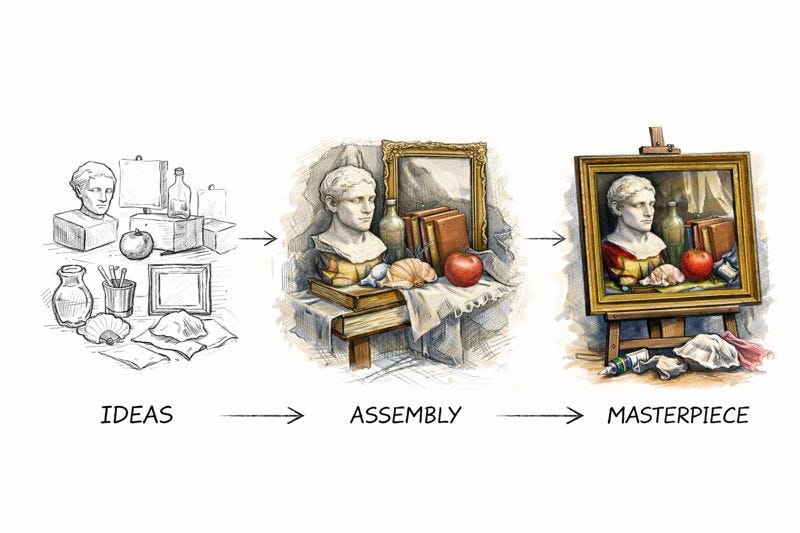
Many conversations about AI creativity still assume a single moment of authorship: you write a prompt, the model responds, and the result is either good enough or disappointing. If it misses the mark, the instinct is to tweak the prompt and try again, as if the problem were insufficient cleverness in wording rather than a mismatch between how humans think and how models operate.
AI collaging starts from a different assumption. Instead of asking an AI to produce a finished work in one pass, you assemble rough, partial, and sometimes mismatched pieces of content and then use the model to reconcile them. The human acts as an editor, deciding what material exists; the AI resolves edges, fills gaps, and imposes coherence.
The difference is easiest to see in practice, so this article follows one topic through two workflows: a single-pass essay, and the same essay assembled from fragments.
The term “collage” is deliberate. In art, collaging is not about hiding seams but about deciding which fragments belong together. AI collaging applies the same idea to generative models by constraining what material they are allowed to work with in the first place.
This turns out to be surprisingly effective for text and surprisingly challenging for images. Large language models readily reconcile semantic mismatches across tone and intent, while diffusion-based image models struggle to respect multiple constraints involving global structure or spatial logic. The difficulty is not visual quality, but control over what the model optimizes for.
This article explores AI collaging as both a practical workflow and a way of understanding the tools we are working with. The first half focuses on text collaging, using a concrete example drawn from historical writing to show how selection and recomposition can change perspective without adding any human-authored prose. The second half turns to image collaging, where the same idea runs headlong into the limits of diffusion models, and where partial solutions reveal more about model behaviour than about artistic results.
AI collaging is not a fully solved technique, and it is not a replacement for skill or judgment. It is a way of working that accepts roughness early, resists the temptation to over-prompt, and treats AI not as an oracle but as a medium—one that becomes more useful once you stop asking it for perfect answers and start giving it imperfect material to work with.
Text Collaging
All Aboard the AI Slop Express!
To make the idea of text collaging concrete, it helps to compare it against the most common alternative: a single prompt asking an LLM to generate a complete piece of writing in one go. The comparison is intentionally narrow. Both approaches use broadly similar instructions—topic, length, tone, and a requirement to be accurate and entertaining. The difference lies not in what is asked for, but in how much thinking is allowed to happen before the final draft exists.
In this first approach, the model is asked to produce a finished mini essay in a single pass. The goal here is not to catch the model making mistakes, but to observe the default perspective it reaches when nothing constrains it.
Write a 4–6 paragraph mini essay on the establishment of the US transcontinental railway. You may draw on related history, politics, economics, or the technologies involved in building or using it, but focus on a US perspective from around the time it was happening. Rather than covering everything, choose one or two angles you think would make for an entertaining but accurate mini essay.
The result is coherent, readable, and competent. It flows well, covers the expected ground, and would be entirely serviceable in many contexts. What it lacks is not correctness or polish, but specificity of perspective. The model chooses a common perspective found in the wealth of training data on this topic.
In the early 1860s, as the United States tore itself apart in civil war, Congress passed legislation that bound the continent together. The Pacific Railroad Act of 1862 was not merely an infrastructure bill; it was a wager that the nation would survive long enough to span itself with iron. With Southern opposition absent from Congress, Northern lawmakers pushed through a project that promised speed, unity, and commercial dominance. The transcontinental railroad was conceived not as a distant ideal, but as an urgent national instrument—one that could move troops, mail, and goods faster than any river or wagon road ever had.
What followed was not a single heroic effort but two rival enterprises racing toward one another across vastly different landscapes. The Union Pacific pushed west from Omaha across the Great Plains, while the Central Pacific fought eastward out of California’s Sierra Nevada. Their incentives were blunt and effective: government bonds and land grants awarded by the mile. This structure encouraged astonishing speed—and equally astonishing corner-cutting. Track was sometimes laid with the expectation that it would be fixed “properly” later. Efficiency trumped elegance; progress was measured in feet of rail hammered into place before nightfall.
The labor that made this possible reflected the social realities of the era. Irish immigrants dominated Union Pacific crews, while the Central Pacific relied heavily on Chinese laborers—men who were initially dismissed as unsuitable for such brutal work, then quietly acknowledged as indispensable. They blasted tunnels through granite with hand drills and black powder, worked in snowbound camps high in the mountains, and endured wages and conditions few others would accept. Contemporary accounts praised engineering feats far more readily than the people who carried them out, a silence that says as much about 19th-century America as the railroad itself.
Beyond steel and sweat, the railroad quietly rewired how Americans understood distance and time. Before its completion, “noon” was a local concept, varying from town to town. Rail schedules made this chaos intolerable. Although standardized time zones would only be formalized later, the logic of the railroad made them inevitable. The country began to think in terms of synchronized clocks and national timetables—a subtle but profound shift toward a more centralized, coordinated society.
When the two lines finally met at Promontory Summit in 1869, the famous golden spike marked more than the joining of rails. It symbolized a new American confidence in scale: the belief that vast problems could be solved by machinery, capital, and organization, even amid political turmoil. The transcontinental railroad did not simply shrink the continent; it reshaped the nation’s sense of possibility—setting a pattern of ambitious, imperfect progress that would define the industrial United States for decades to come.
This serves as a baseline: what a capable LLM produces when told to “just write the essay.” It is difficult to object to this version, but equally difficult to remember why it was written this way rather than another.
Feeding the Steel Mill
The second approach starts with a different instruction. Instead of asking for an essay, the model is told that the conversation is exploratory—that it is helping to assemble material for a later article. The prompt makes it explicit that while the interaction is conversational, some answers should arrive in a form suitable for direct inclusion in that future piece.
This constraint is not negotiable. Collaging only works if the output comes in chunks that can later be selected, reordered, or discarded. Without pre-formed chunks, there is nothing to select later—and without selection, collaging collapses back into drafting.
I’m exploring the establishment of the US transcontinental railway by breaking the topic into focused questions rather than asking for a full essay. Please answer each question directly and also include a paragraph or two suitable to put in the future article. Aim to be entertaining but accurate, grounded in a US perspective from around the time these events were happening. Do not attempt to synthesize the answers into a single narrative or essay.
From there, the interaction proceeds as a structured Q&A. The questions explore the topic, as I intentionally chose a topic I’m not an expert on. They also help find an interesting angle for the writing.
What caused the start of the project?
Who supported and who opposed the project, and why?
Was the project ambitious or challenging compared to other contemporary rail projects?
How were the crews supplied? Was it dangerous living?
Did any of the temporary towns become permanent? Why so or not?
When people think of that time period now, they think of gold rushes and outlaws. Can you speak as to how that played out in reality at the time?
How did mining (for gold, iron or coal) interact with the railroad?
What was the human cost of the ghost towns?
How did the great rail project affect the American psyche?
The answers vary. Some passages are immediately useful; others repeat ideas or contain phrasing that won’t survive intact. At this stage, none of that is a problem. The goal is accumulation, not consistency. What follows are not draft paragraphs, but standalone fragments written in response to different questions, with no attempt at consistency or flow.
Along the advancing line, towns sprang up almost overnight—canvas cities of saloons, gambling tables, freight yards, and false-fronted buildings that promised permanence they rarely delivered. When the track moved on, many of these places withered just as quickly. A town that existed only to feed, water, or entertain the workforce had little reason to remain once the whistles faded into the distance.
Some towns clung to the rails and refused to let go. Cheyenne began as little more than tents and whiskey barrels, yet it sat where the railroad needed to pause, repair, and reorganize. Engines lingered. Crews rotated. Commerce followed. What might have been another fleeting camp hardened into streets, offices, and permanence.
Few families chased the railhead itself. They waited until the shouting moved on. Once tracks were fixed and trains ran by the clock, uncertainty began to thin. Survey stakes turned into plots; tents into houses; rumors into prices. The settler accepted danger and hardship, but not isolation. The railroad’s greatest lure was not opportunity in the abstract—it was the assurance that one could fail, try again, and still remain connected to the world.
The Cutting Room Floor
Only after this exploratory phase does the actual collaging happen. Selected passages are copied out of the conversation, placed into a separate document, and rearranged. Weak material is dropped. Strong material is moved closer together. Importantly, in this example no new prose is added by a human. This constraint keeps the comparison focused on selection rather than writing skill.
Once the fragments have been assembled, they are pasted into a fresh chat with a final instruction to produce a mini essay based on the provided content.
Write a 4–6 paragraph mini essay on the establishment of the US transcontinental railway. Base it on the provided content. Focus on a US perspective from around the time it was happening. Rather than covering everything, choose one or two angles you think would make for an entertaining but accurate mini essay.
The resulting essay is coherent and readable, but different in character from the one-shot version. It reflects the angles that dominated the exploratory conversation and sidelines those that didn’t appeal to the editor. The change is a human driven perspective.
For years the republic had been stretched across a continent it could scarcely traverse. California might fly the American flag, yet it remained nearer by ocean than by land, tethered to the Union by rumor, mail steamers, and faith. The Civil War stripped away any remaining illusion that such distance was merely inconvenient. A nation fighting for its survival could not tolerate provinces reachable faster by foreign waters than by domestic soil. What had long been debated as extravagance or speculation became strategy. Iron rails would be driven west not as a luxury, but as a necessity—binding the continent by movement where speeches and treaties had failed.
The railroad advanced less like a road than like a living thing. Camps migrated with the track, dragging kitchens, forges, tents, whiskey, powder, and iron behind them. One week a stretch of prairie lay empty; the next it throbbed with men, doubled prices, and sleepless noise. Towns appeared overnight, built of canvas and confidence, promising permanence they had not yet earned. Some hardened into places of consequence when the railroad paused—Cheyenne, born of tents and barrels, survived because engines lingered and commerce followed. Others existed only for the railhead itself. When the track moved on, they emptied with shocking speed, their reason for being gone in a single whistle blast.
To mistake this turbulence for lawlessness was comforting but wrong. The iron road did not favor bandits for long. Rail towns were crowded, connected, and talkative; familiarity was the outlaw’s undoing. News traveled faster than rumor ever had, and escape narrowed instead of widening. The frontier still held space, but the railroad left little room to disappear. Discipline, not bravado, proved the safer bet. The West, it turned out, was not tamed by guns alone, but by schedules, ledgers, and the relentless regularity of steel on steel.
The most unsettling legacy lay not in violence, but in abandonment. Ghost towns were not born empty—they were emptied. Merchants who stocked for crowds found themselves guarding silence; families who had hauled their lives across half a continent packed again, poorer in both goods and certainty. The lesson cut deep: prosperity could be provisional, maps could lie, and forces larger than any individual—routing decisions, capital, distance—could erase a future without warning or malice. Effort and optimism were no guarantee against a line drawn elsewhere.
Beneath all this ran a quieter cultural reckoning. The gold rush had promised that fortune awaited the determined individual, that success was something to be found by those bold enough to look. The railroad proposed a different creed. Wealth was no longer discovered; it was engineered. No man could lay track across mountains alone, nor profit from it without coordination and compliance. Americans continued to praise individual grit even as the economy rewarded mastery of systems. The mythology endured because it defended dignity, insisting the door remained open. Yet the iron road, mile by mile, was quietly teaching the nation that the future belonged not to the lone seeker, but to those who could build—and endure—structures larger than themselves.
A Matter of Perspective
What changes between the two essays is not fluency or factual accuracy, but point of view. The collaged version inherits its character from what was selected upstream. The model is not being asked to invent a perspective; it is being asked to reconcile one that already exists in fragments.
This is where text collaging quietly excels. Large language models are unusually good at resolving semantic mismatches across reused material. If you constrain what they are allowed to work with, they will usually find a way to make it cohere. The leverage lies not in rewriting sentences, but in deciding which sentences ever meet.
The example above uses what might be called loose-fit collaging. The fragments are allowed to move freely, and the model is responsible for reconciling them into a coherent whole. This makes it useful for discovering perspective, but it is not how most real articles are written.
In a tight-fit collage, human-authored passages act as fixed anchors. The model is constrained to work around them—filling gaps, smoothing transitions, or resolving local mismatches—without being allowed to overwrite the author’s intent. In practice, this is the more reasonable default: human writing establishes the shape, and the model assists where friction appears.
Collaging does not replace writing. It changes when and where writing exerts leverage.
Image Collaging
Dragon in a Cave
My goal was to place an AI-generated blue serpentine dragon into a cave scene I had previously rendered using Midjourney. As with the text examples earlier, this was a loose-fit collage: the fragments were deliberately rough, partially contradictory, and not meant to align cleanly without intervention.
I’m aiming for speed and ease of use rather than polish. Each edit took less than five minutes using basic selection, cut, rotation, and paste tools in Paint.net. I’m not an artist, and neither is much of my target audience. The point here is not technical skill, but whether diffusion models can reconcile a crude, human-assembled collage into a coherent scene.
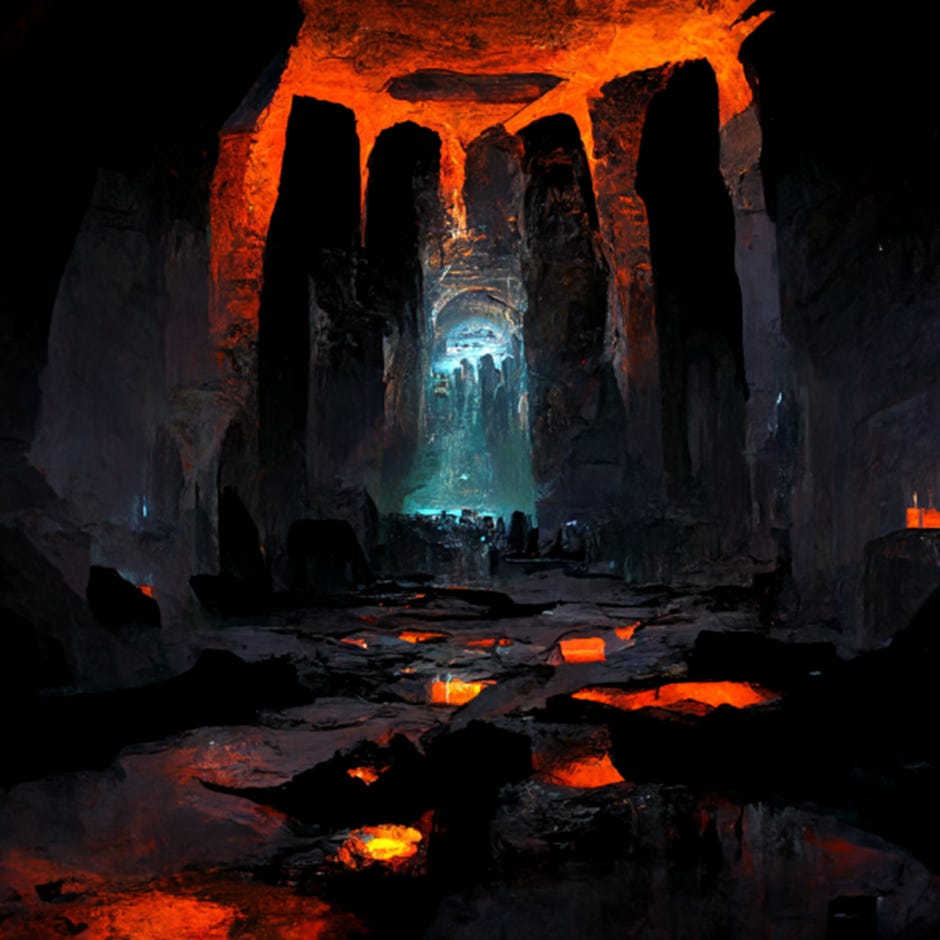
This is the base scene the model is asked to work with: a plausible but stylized cave interior. Importantly, it already contains some visually striking elements that are ambiguous in physical terms—areas that look good, but don’t obviously obey three-dimensional structure.
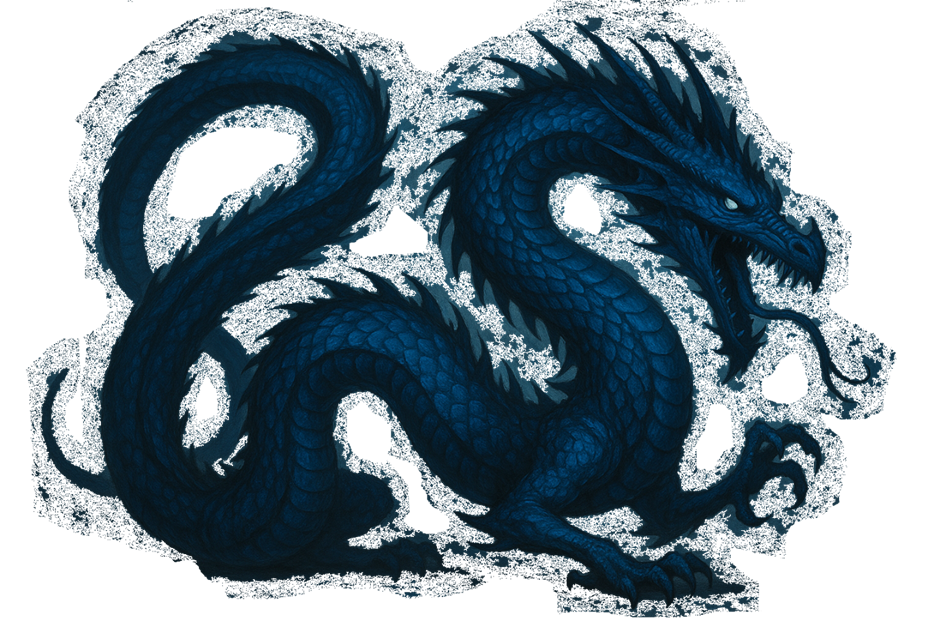
This dragon image was intentionally cut out poorly. Rather than refining the edges, I wanted to test how tolerant the model would be to imprecision, and whether it would still respect the intended action.
At this stage, the dragon is not yet “in” the cave. It is simply a fragment with a clear identity but no spatial grounding.
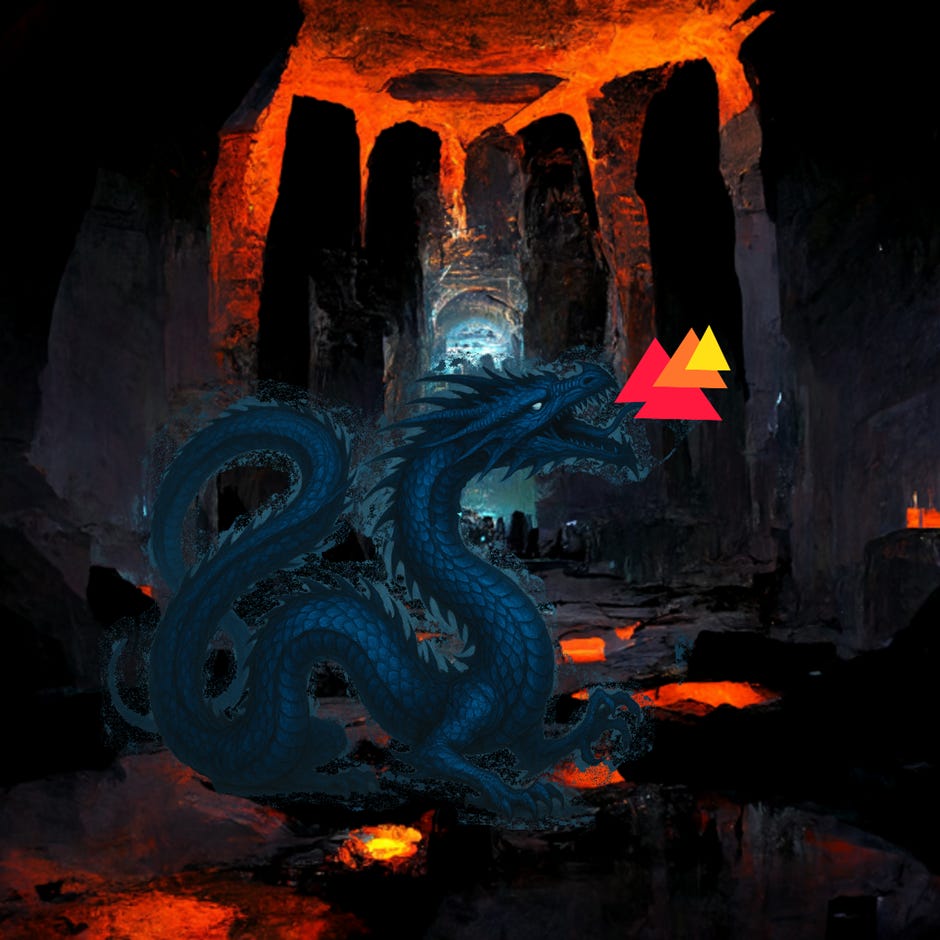
The collage itself was created manually. I pasted the dragon into the cave, then cut, rotated, and re-pasted its head so that it was looking upward rather than down. To indicate intent rather than realism, I drew simple yellow and orange triangles extending from its mouth to suggest fire.
The result is not a finished image. It is an explicit instruction rendered visually: this dragon is here, it is looking up, and it is breathing fire. There is no tight fit here. Nothing in the collage is protected or treated as immutable.

The prompt was deliberately simple:
Draw an image integrating the dragon from the second uploaded image into the first uploaded image, with the dragon looking up breathing fire.
As noted in the prompt I attached the picture of just the dragon as well, because the collaging process resulted in a lower res slightly damaged dragon in the scene, and I wanted to preserve detail.
The resulting image is visually impressive, but revealing. Several details in the background change, even though they were not part of the collage itself. The cave floor shifts, as if the model is uncertain where the dragon is allowed to stand and creates new geometry to support it. In multiple experiments, a central bluish-white area in the original cave image disappears entirely.
My working hypothesis is that this is not random drift, but structural resolution. Early Midjourney models were notorious for producing physically impossible—if beautiful—images. More recent models appear to enforce spatial plausibility more aggressively. Faced with a large inserted object that needs grounding, the model simplifies or suppresses elements that conflict with a coherent three-dimensional scene.
This highlights a key difference from text collaging. Language models reconcile fragments semantically. Diffusion models attempt to reconcile them physically. When constraints are unclear, they do not merely smooth edges — they reassert global structure.
Day At the Beach
This example includes content in different ways. The goal is a seaside family picture. I started by generating a beach picture in a painted style.

I added a selection of objects to the scene, intentionally using clashing styles to test how the model would resolve them:
Stock photo of a toddler
Stock photo of a dog
Stock photo of a crab
Simple circle as a ball

I intentionally gave as little guidance as possible in the text prompt:
Draw a beach scene closely related to the attached.

The generated image is very close to what I envisioned. There are a few points to note. The perspective shifted slightly. I consider this fairly benign. It’s likely to make more space for objects. The sea, chairs, umbrellas and plants are virtually identical. Both toddler and crab are essentially where we put them, although the toddler’s clothing has been changed to suit the beach location. The dog has been replaced with a different breed – I guess all families have a golden retriever or lab. The dog has caught the ball. Although not what I intended, the resolution is understandable. The collage provides no thrower and no clear trajectory, leaving the model to resolve the ambiguity by collapsing the sequence into a single, typical outcome: the dog already has the ball. A girl has been placed next to the toddler, which makes narrative sense as people do not usually leave young children alone at a beach.
Hey Buddy
This image started as a text prompt only, and then I attempted to use collaging to fix errors in it.
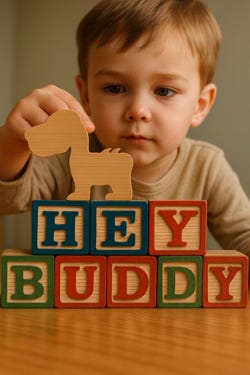
Draw me a near photorealistic picture of a child building a horizontal row of blocks ‘buddy’ with a horizontal row of blocks ‘hey’ on top. The camera will be close to the blocks and table top and focused on the blocks. The child will look huge and unfocused from this perspective.
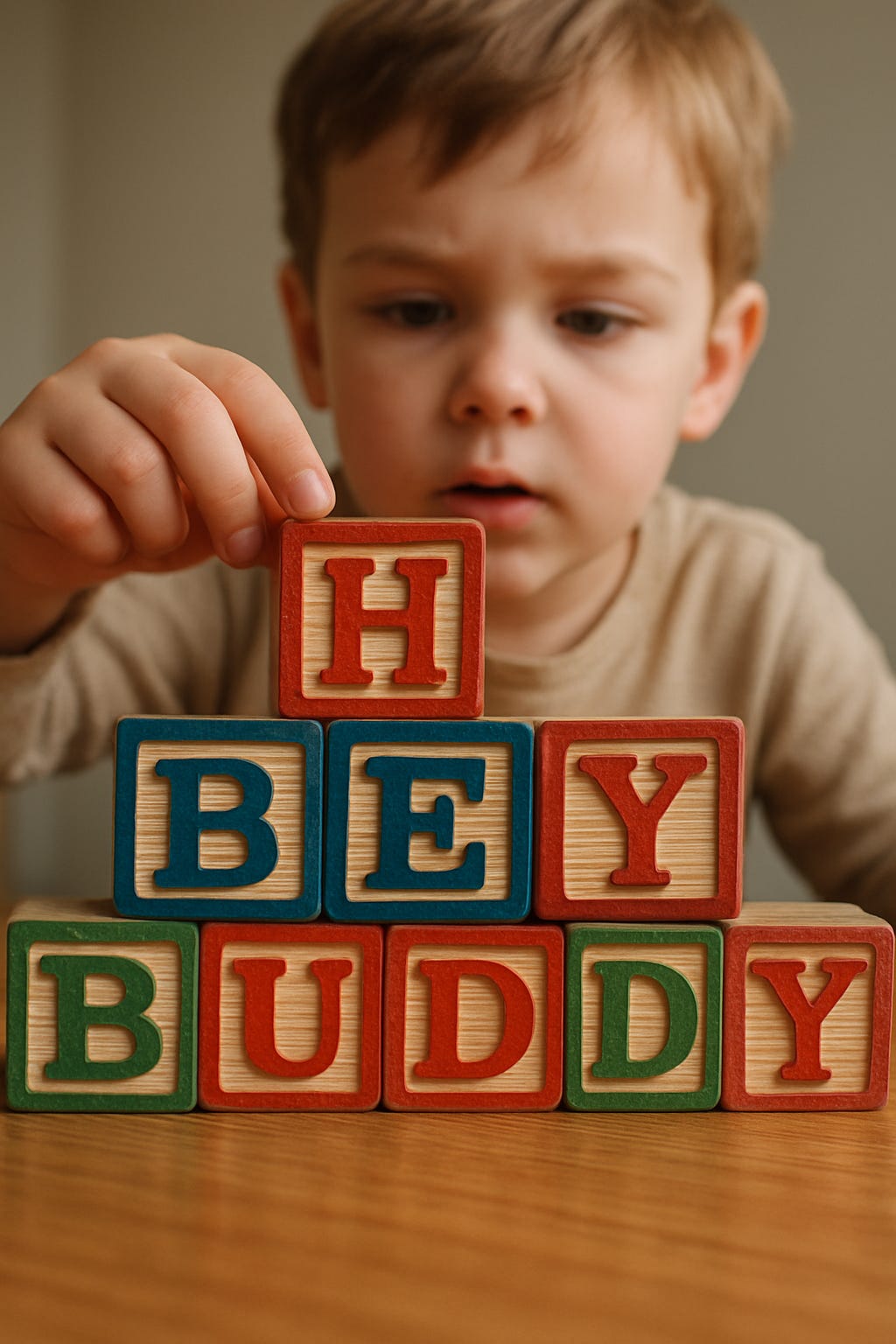
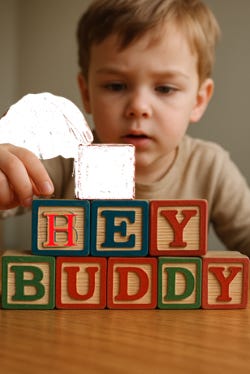
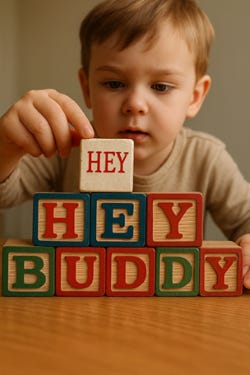
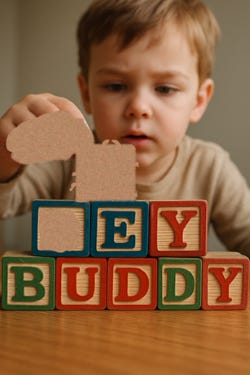
Although they are improving, diffusion models are known to have issues with text and spelling. My goal here is to fix the spelling and remove the extra block. Little did I know that my to-do list was the equivalent of “1. Buy milk 2. Find the holy grail”.
A Comedy of Errors
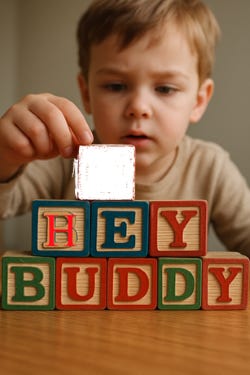
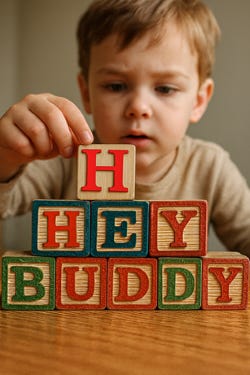
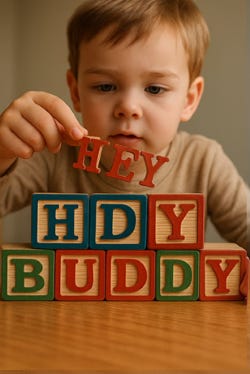
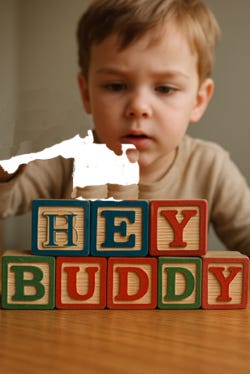
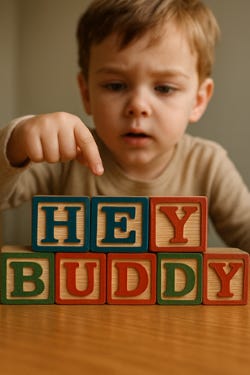
I’ll summarize a few of my attempts below:
Input
Output
Input

Output
Input
Output
Input
Output
Input
Output
Input
Output
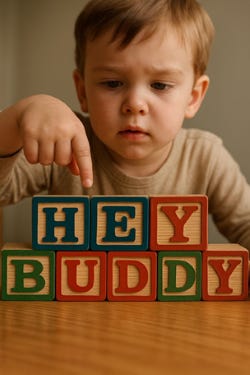
As you can see, fixing the spelling error was relatively trivial. You can erase the letter and put a letter over the top, and even if size, font, color etc aren’t a complete match, diffusion will fix it.
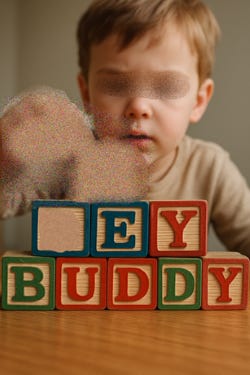
Object erasure is a whole other kettle of fish. I started with the assumption that I could just remove the block. However the model sees a block-shaped hole, and fills it with a block. I tried using generic colors or random noise to fill it, it still noticed the gap. I erased the hand, it put it back. I thought about why and how it could replace so much missing detail, and it led me to a revelation.
The Court of Diffusion
You have been judged guilty of giving the child a block they weren’t meant to have. You must convince a judge and jury of one that no crime was committed, or you’ll be stuck with that block forever. Let’s check out the evidence.
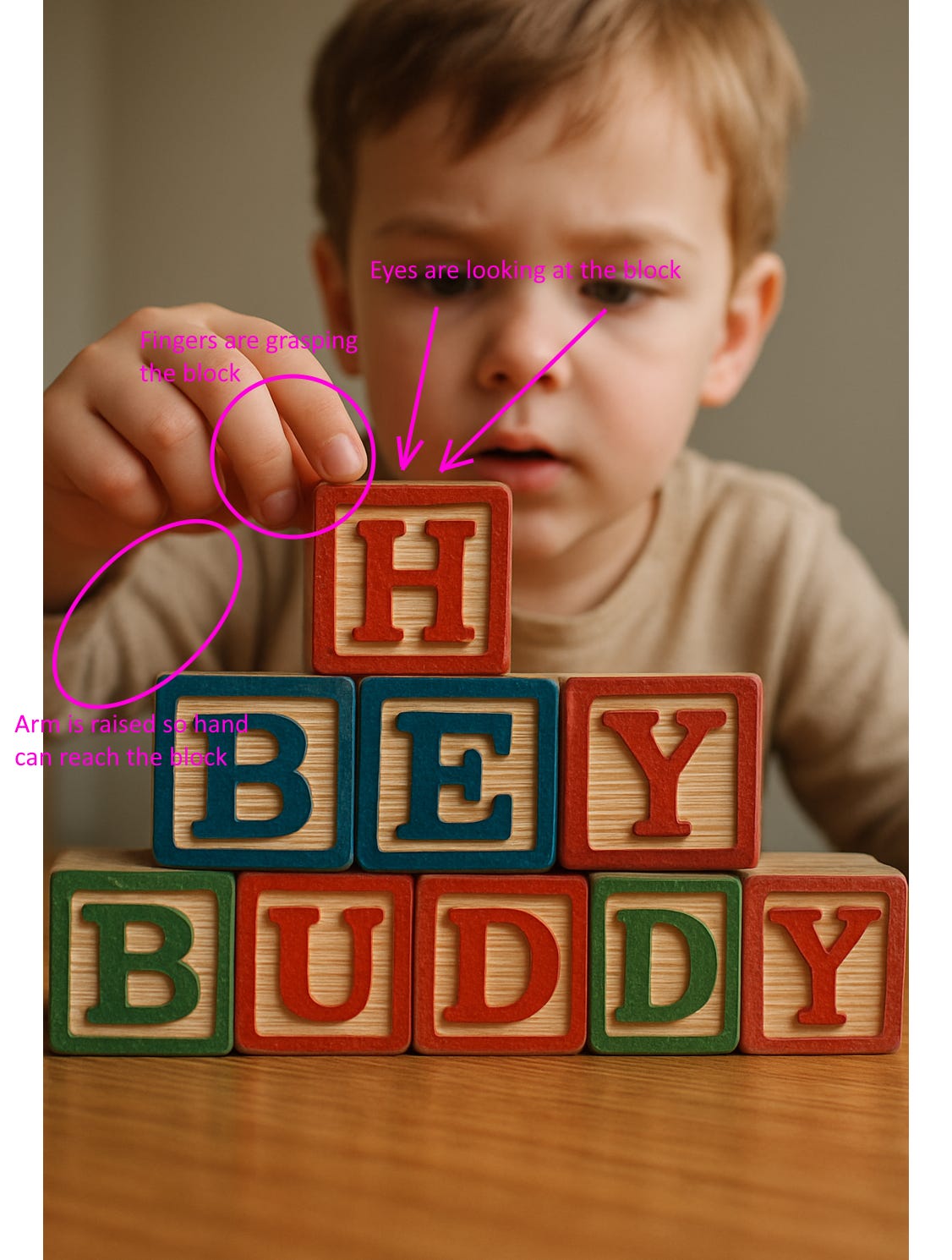
Convincing the model not to draw that block means removing or replacing all the cues. That’s why my two most successful attempts involved either painting the arm away, which was more work than I wanted to do in this workflow, or adding chaos and randomness to a large area. For the latter approach I followed the steps below:
Cover the object to remove with a color which is common in that part of the picture.
Select an irregular larger area around the region to remove.
Apply an effect that moves pixels unpredictably, such as “frosted glass”. This breaks up the edge.
Add noise. This both makes the area seem less like a consistent surface and aligns with diffusion’s roots in bringing structure out of randomness.
Note that neither is a complete guaranteed workflow, but if you find yourself in my situation, it’s a starting point.
Mazes Are Difficult
To push image collaging further, I tried using diffusion to transform an already generated 2D maze into a navigable 3D maze populated with characters. As the title suggests, this turned out to be far more difficult than expected.
The starting point was a 2D maze generated by code. I deliberately thickened the lines and increased contrast to ensure the structure was clearly visible to the model.
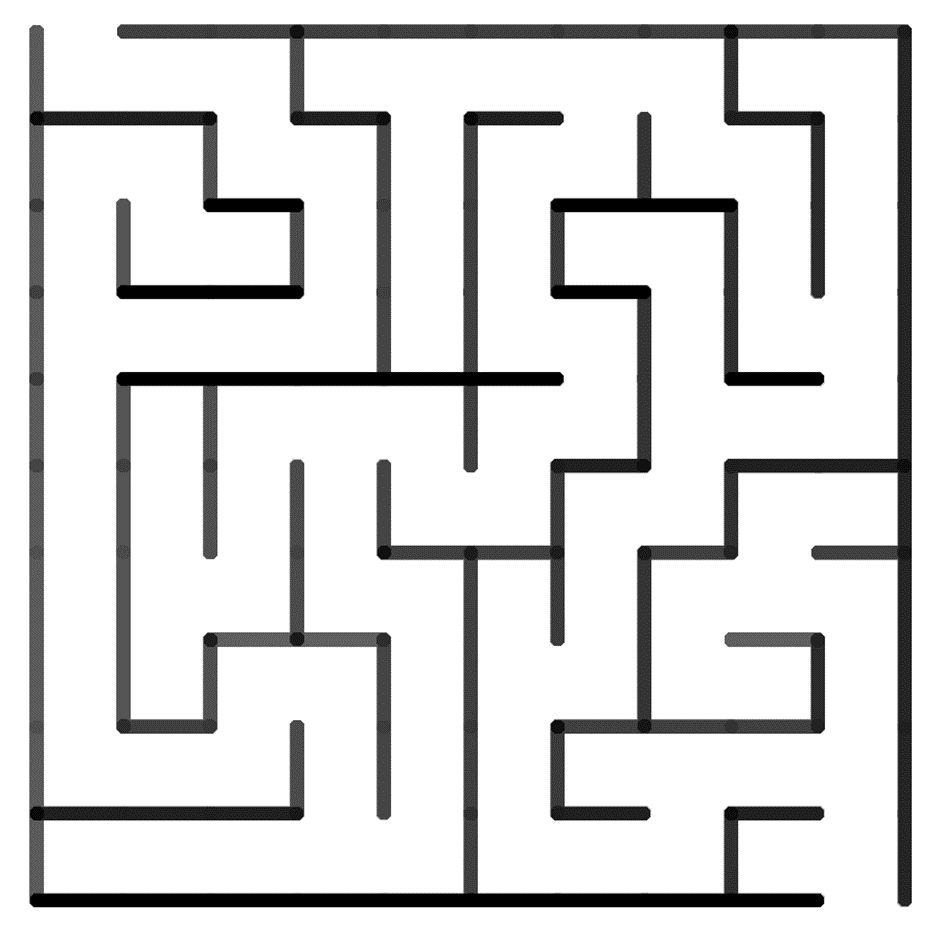
When I used a simple prompt like the below, the results were mixed.
Draw the attached as a 3d hedge maze.
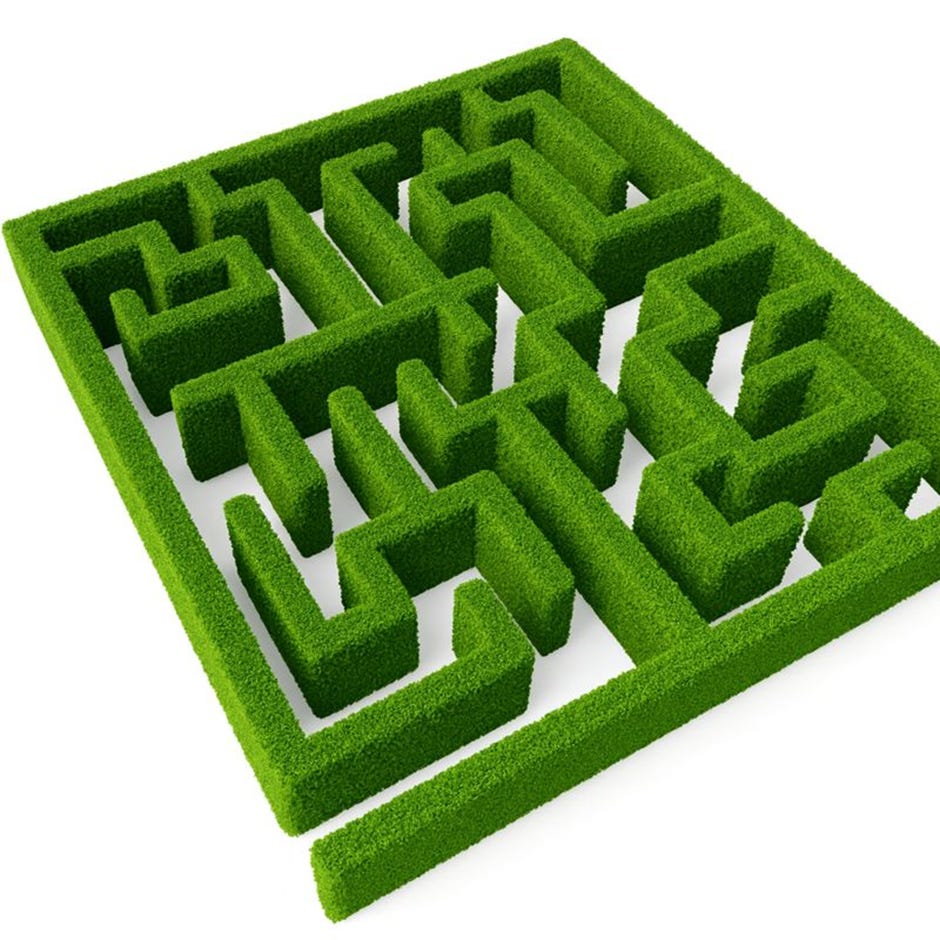
The results were mixed. At a glance, the overall shape appeared intact, but closer inspection revealed that openings had been added and removed arbitrarily. The resulting maze was no longer solvable. When additional instructions were layered in—mood, lighting, or characters—the fidelity degraded further until the output resembled a generic maze-like texture rather than a specific structure.
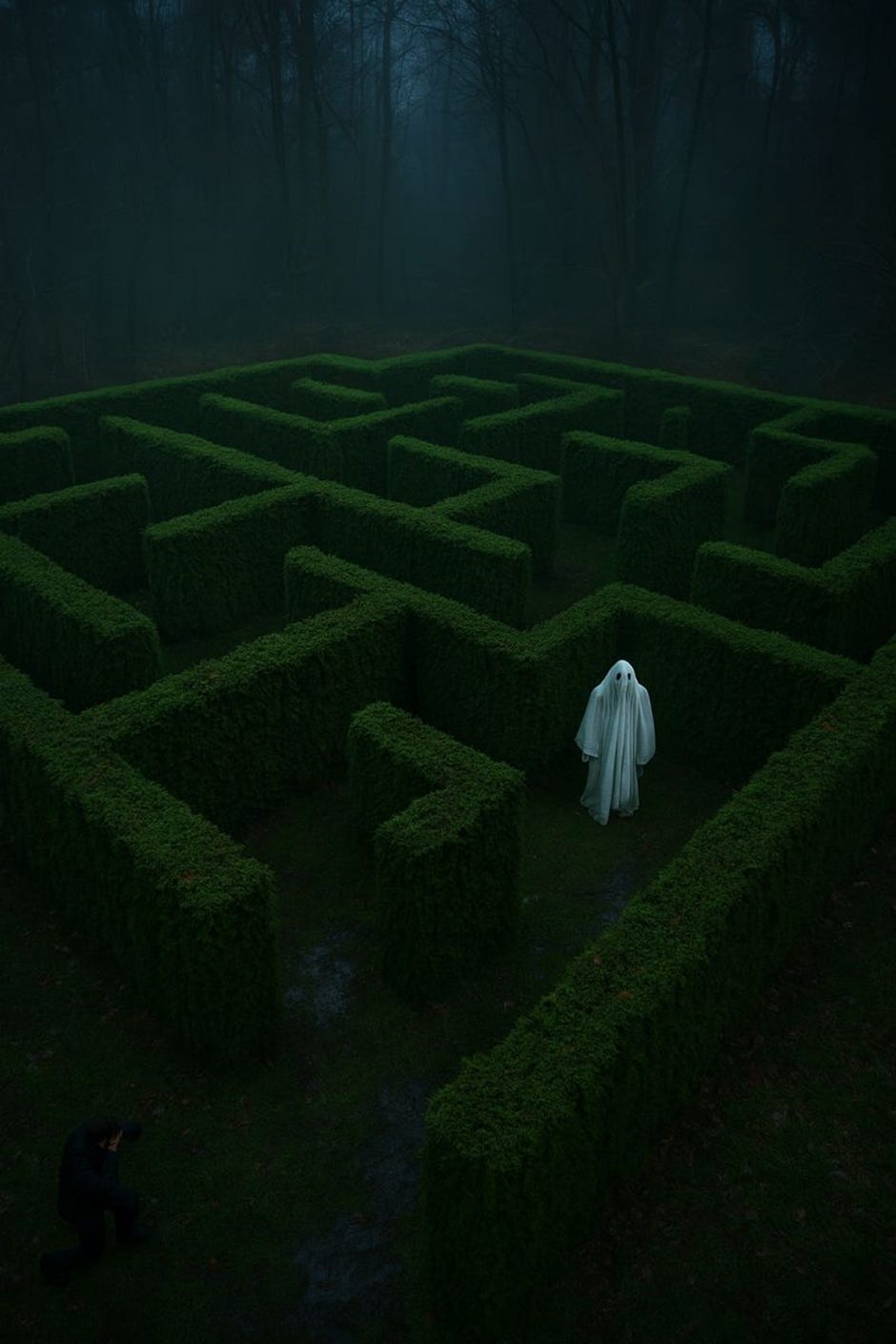
The most reliable approach was to reduce the transformation to step-by-step. First, I asked the model to recreate the maze from a strict bird’s-eye view, keeping the input and output nearly one-to-one. From there, I introduced depth and perspective.
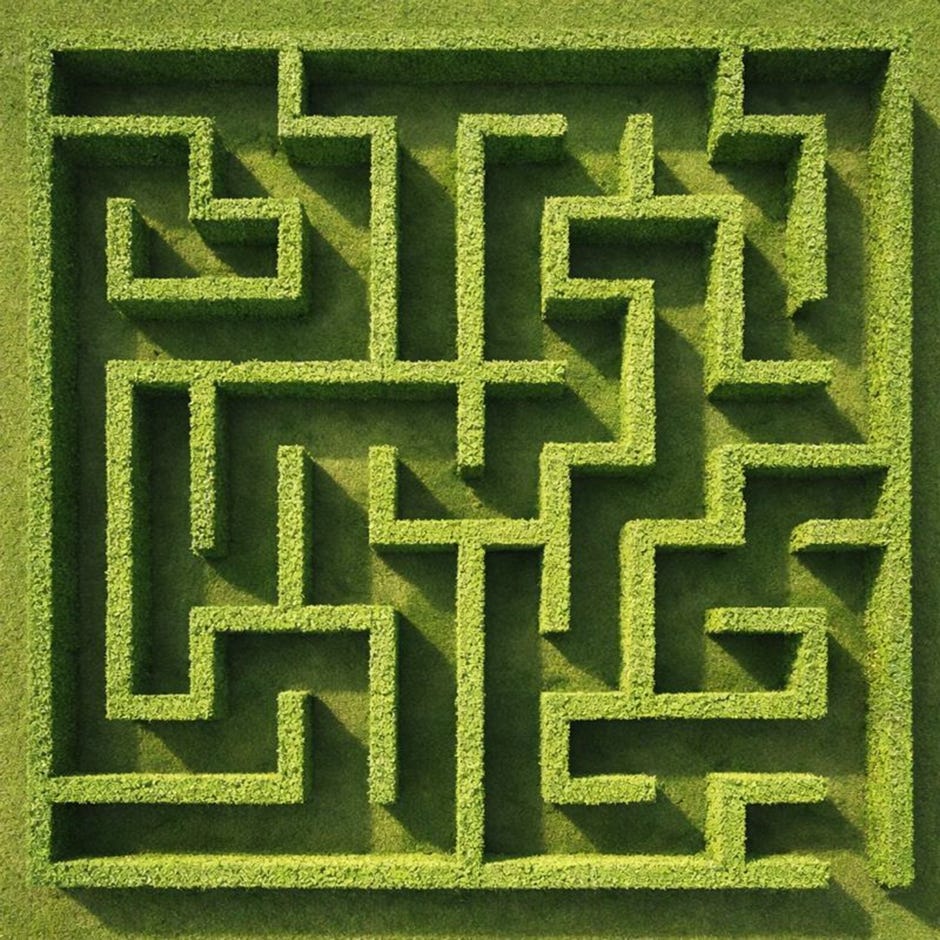
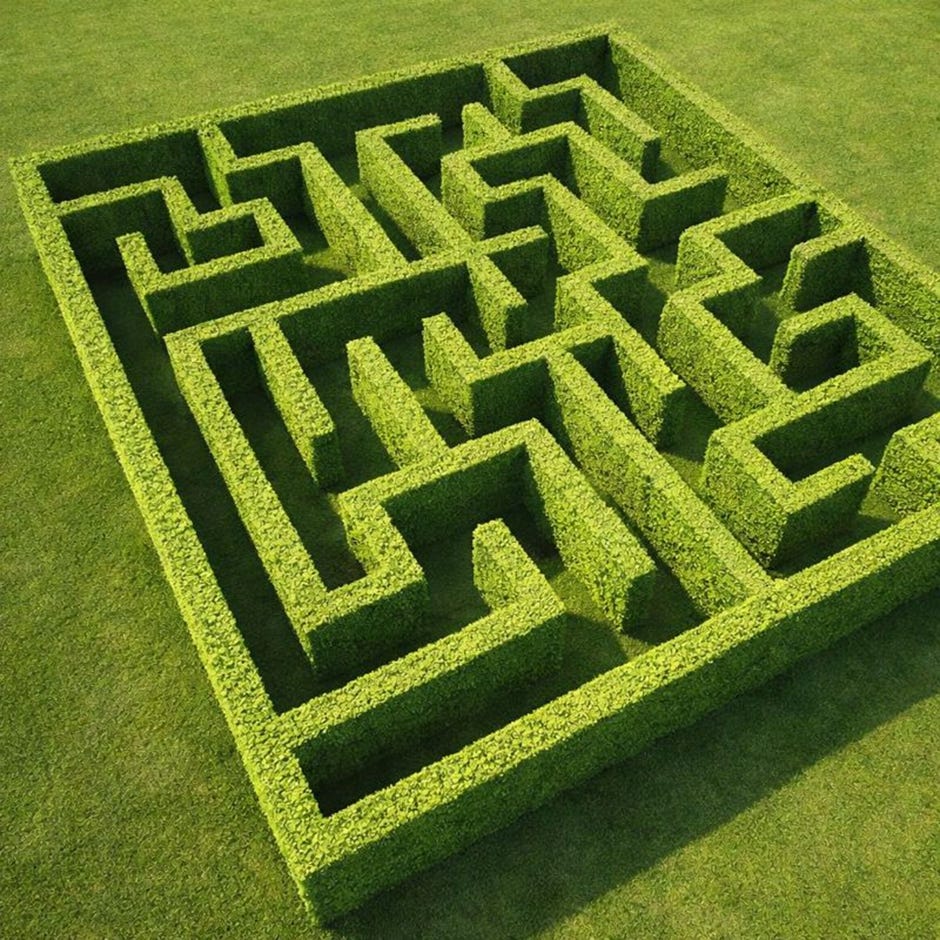
This produced a visually convincing 3D maze with high structural fidelity. However, even in this constrained setup, a consistent failure emerged: the entrance was often sealed. Across multiple runs, the model would “repair” the maze into a closed form, even when the opening was clearly present in the source.
Adding characters exposed deeper limitations. The model appeared to have no concept of distance within the maze’s topology. Requests to place characters near one another were satisfied visually, even if walls separated them. In other cases, the presence of a character took priority over the maze itself—the layout warped to accommodate the figure, undermining the structure it was meant to preserve.
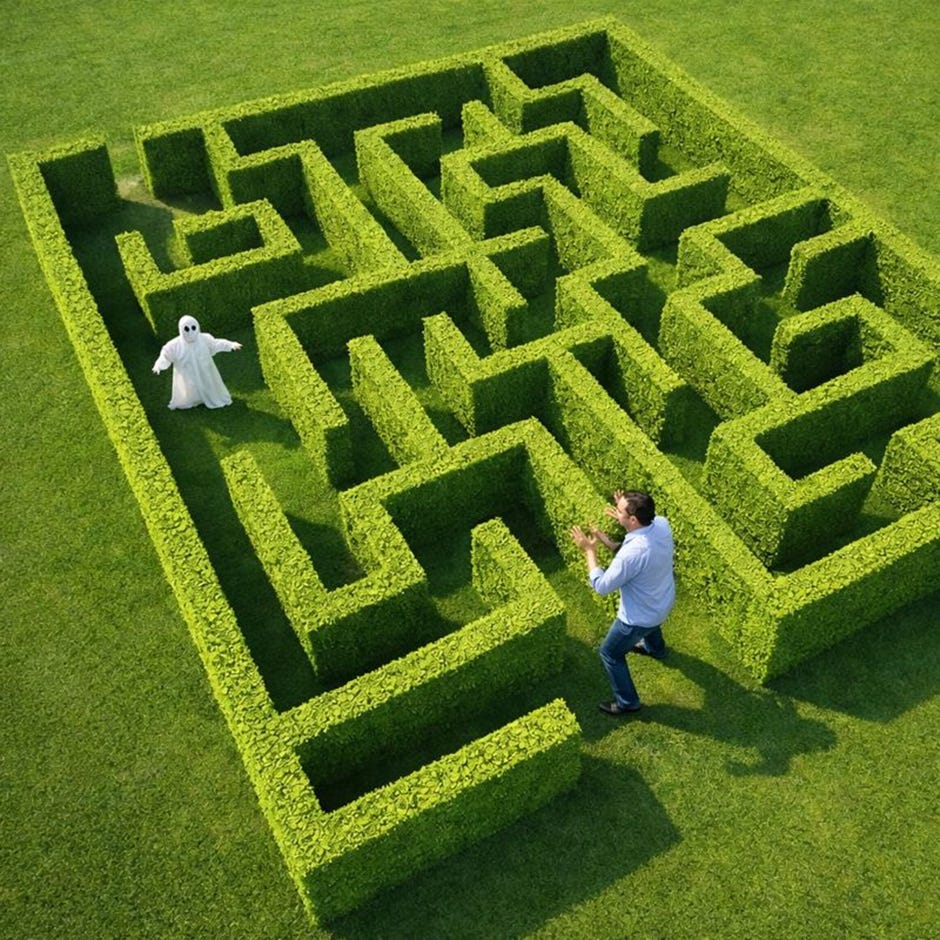
Taken together, these failures point to a broader pattern. Mazes are not just complex shapes; they are tightly coupled systems where every wall participates in a global constraint. Diffusion models appear to interpret mazes as visual patterns rather than navigable spaces. They can reproduce the look of a maze, but not the invariant relationships that make it function as one.
In other words, this is not a rendering problem. It is a constraint problem. And it illustrates a broader limitation of diffusion-based image generation: when correctness depends on preserving global structure rather than local appearance, visual plausibility wins over logical consistency.
Sketches as Layout
I experimented with using sketches as a way to structure image generation, rather than collaging together realistic fragments. This approach is certainly capable of producing attractive images, but in practice it offered much less control than I expected.
In hindsight, this is understandable. A sketch is deliberately low fidelity: it communicates rough layout and intent, not precise geometry or constraints. When used as conditioning, the model treats it as a suggestion rather than a commitment. It fills in style, scale, lighting, and even narrative details based on its own priors, often diverging significantly from the sketch’s intent.
This becomes a problem if the goal is not exploration, but execution. When you already have a specific vision, sketches tend to give the model too much freedom. The result can look polished while quietly violating the structure you were trying to preserve.
I eventually obtained usable results, but only by repeatedly editing the generated images using collaging techniques afterward. At that point, the sketch was no longer guiding the process so much as initiating it. For this workflow, sketches functioned better as prompts for ideation than as layouts to be respected.
Why This Works Now
Until recently, image collaging was not a practical workflow. Early diffusion models offered little control beyond repeated prompting and regeneration. If the model misunderstood a scene, there was no reliable way to correct it incrementally. You did not preserve structure – you started over.
ControlNet marked an important shift. By conditioning generation on explicit structural signals—edges, depth, pose, segmentation—it made it possible to specify not just what should appear, but what should remain stable. Collaging became viable, but only for users willing to manage additional models, pre-processing steps, and tightly constrained inputs.
More recent image models have absorbed lighter versions of these ideas directly into their base architectures. Spatial priors are stronger, image to image conditioning is more stable, and partial edits are more likely to respect surrounding structure. This is why rough collages, crude edits, and incomplete constraints now work at all. The techniques shown in this article depend on that evolution; they would not have been usable even a few years ago.
This shift does not make image collaging easy or predictable. It simply makes it possible.
Closing Thoughts
Across both text and images, AI collaging works for the same underlying reason: modern generative models are good at reconciling constraints, even when those constraints arrive fragmented, partial, or out of order. What differs is not the workflow, but the kind of coherence each model enforces when resolving them.
Language models reconcile locally. They can stitch together ideas written at different times, in different voices, and with different assumptions, and still arrive at a coherent narrative. Diffusion models reconcile globally. Faced with ambiguity, they reassert a physically consistent scene, even if that means deleting objects, warping geometry, or simplifying structure.
Many of the image failures in this article can be understood in terms of scale and conflict. Image to image generation becomes difficult when a change affects a large area of the image, or when multiple constraints collide with strong priors in the training data. For example, transformations like night vision illustrate this clearly: they have to be applied globally, they clash with other lighting conditions, and due to the overwhelmingly military and surveillance-biased examples the model has seen during training they may skew subject matter. What appears to be disregard for intent is often the model choosing consistency over contradiction.
What collaging makes visible is where reconciliation happens — and where it breaks. In text, meaning bends before structure does. In images, structure bends before meaning does. Once that difference is understood, the model’s behavior becomes far more predictable.
In both modalities, the human contribution is not continuous prompting or stylistic cleverness. It is selection. Deciding which fragments exist at all, which constraints are negotiable, and which must be protected matters more than refining the final instruction.
Collaging does not replace writing, illustration, or judgment. It shifts where judgment has leverage. For work that benefits from rough exploration followed by deliberate assembly, that shift can be powerful. For work that demands precision from the outset, it may not help at all.
The value of collaging is not that it makes models more creative, but that it makes their priorities legible. Once you stop asking for perfect answers and start giving imperfect material to work with, the limits of each model become clearer — and, in many cases, more useful.